Direct Answer
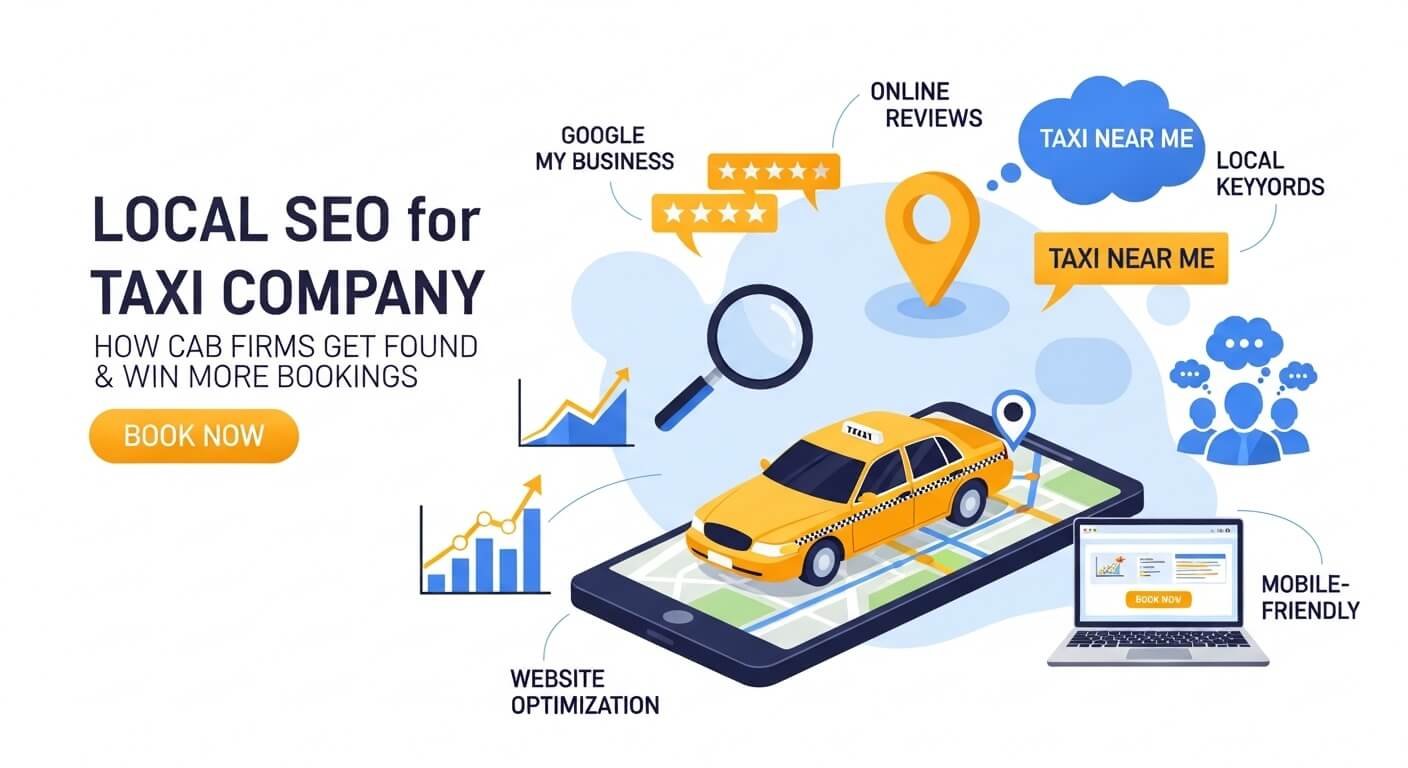
Local SEO for taxi company is the practice of optimizing a taxi or private hire business’s online presence to appear at the top of Google’s local map pack, Google Maps, and organic search results when passengers in the service area search for rides. Taxi searches are real-time, location-sensitive, mobile-dominant, and often voice-driven. Unlike law firms or home services, taxi passengers don’t spend hours comparing options — they need speed, clarity, and immediate availability. Local SEO for taxi companies focuses on dominating Google Maps, capturing emergency and planned ride intent, and converting clicks into calls or bookings instantly.
Why Taxi Companies Need Local SEO More Than Any Other Business Type
By 2026, the street hail has been eclipsed by the search bar. The commuter no longer waves from a curb — they unlock a phone, type “taxi near me,” and trust the first name they see.
The consequences are direct. A taxi company that doesn’t appear in the top three Google Maps results for “taxi near me” in their operating area is invisible to the vast majority of passengers who search before booking. Those passengers don’t scroll to the next page or try a different search term — they call the first number they see.
Local SEO for taxi companies is also particularly valuable compared to other marketing channels. Aggregator platforms like Uber and Bolt take 20–30% commission on every ride. Google Ads for taxi keywords cost $3–$15 per click with no guarantee of conversion. Organic local search drives bookings at zero per-click cost — and once ranking positions are established, they deliver leads continuously without ongoing ad spend.
Google Business Profile: The #1 Priority for Taxi Company Local SEO
For taxi businesses, Google Maps is everything. Most bookings start and end inside Google Maps. This means your Google Business Profile isn’t just another marketing channel — it’s the primary booking interface for search-originating passengers.
Category selection: Your primary category should be “Taxi Service.” Add secondary categories for each specific service you offer: “Airport Transportation Service,” “Limousine Service” if applicable, “Car Service.” Avoid generic categories like “Transportation Service” unless the additional services are core. Do not over-categorise — it dilutes your relevance signal.
Services listing: This is where most taxi companies leave serious ranking potential on the table. List every service type individually with a description:
- Airport transfers (to/from Heathrow, Gatwick, Stansted, etc. — name the airports you serve)
- 24-hour taxi service
- Corporate taxi accounts
- Long-distance transfers
- Event transportation
- Hotel pickups
- Train station pickups
Empty service sections lose urgency and trust. Passengers searching for a specific service — “taxi to Heathrow Terminal 5” — are more likely to book a company whose profile explicitly lists that service than one with only a generic “taxi service” description.
- Photos: Fleet photos with vehicle registration plates visible, driver photos in professional presentation, branded exterior shots, and vehicle interior shots showing cleanliness and condition. High-quality photos of cars and drivers boost professionalism and show Google’s algorithm that your profile is complete and active.
- Reviews: Recency matters enormously for the taxi company, GBP. A company with 15 reviews in the past month will often outrank a company with 200 total reviews, most of them from 2022. Build a systematic review collection process: after every completed ride, send a text message with a direct Google Review link. For airport transfers and corporate accounts, a brief follow-up with a review request is standard professional practice.
Taxi-Specific Keyword Strategy
Passengers don’t search in generalities — they search in specifics. “Taxi service” is too broad. What converts is “airport taxi Boston,” “24/7 cab downtown Toronto,” or “taxi to Heathrow.”
The taxi keyword universe divides into three intent categories:
- Emergency / immediate need keywords: “taxi near me now,” “cab near me,” “taxi [area] right now.” These searches convert instantly — the passenger needs a ride within minutes. For these, you need the top map pack position and a phone number visible above the fold.
- Planned journey keywords: “taxi to Heathrow from [city],” “airport transfer [city],” “taxi to [train station].” These are booked hours or days in advance. For these, you need both map pack presence and dedicated landing pages that rank in organic results.
- Comparison keywords: “reliable taxi company [city],” “best taxi service [city],” “taxi company with child seats [city].” These are passengers researching before booking. Dedicated content pages targeting these queries earn both organic rankings and trust before the first call.
Build individual landing pages for each airport transfer route you serve, each major train station, and each city or suburb you operate in. Create separate pages for each city or neighbourhood you serve, with content customized with local sights and specific route information to better engage riders in those places.
Local Citations for Taxi Companies
Beyond Google Business Profile, consistent citation building across directories that passengers actually use is a meaningful authority signal. For taxi companies, the highest-value citation sources are:
- Yelp, Bing Places, Apple Maps (general local)
- Taxi aggregator directories that rank highly in local searches
- Local Chamber of Commerce and business association listings
- TripAdvisor (particularly valuable for tourist and hotel transfer traffic)
- Airport and train station information pages where local taxi listings are featured
- Hotel concierge referral networks (offline relationships that generate online citations)
The critical requirement: NAP data must be identical across every listing. Taxi companies frequently operate under multiple trading names or have changed phone numbers — audit every existing citation and correct inconsistencies before building new ones.
AI and Voice Search for Taxi Companies
For taxi companies, AI Overviews, ChatGPT, Perplexity, and voice search are all channels that need optimization. Voice search is particularly important for taxi bookings — passengers frequently ask their phone’s voice assistant for a taxi while driving, walking, or in situations where typing is impractical. Voice search returns a single answer rather than a list of results, making the top map pack position even more decisive.
Optimizing for voice search requires: ensuring your GBP is fully complete (voice search pulls directly from GBP data), having a mobile-optimised website that loads in under 2 seconds, and publishing FAQ content that directly answers the questions passengers ask verbally (“What taxis are near me?” “How much is a taxi to the airport from [city]?”).
HighSoftware99.com’s taxi company SEO service includes voice search optimization and AI visibility as core components — ensuring clients are the answer when passengers ask their phone rather than type into it.
Frequently Asked Questions About Local SEO for Taxi Companies
What is local SEO for a taxi company?
Local SEO for a taxi company optimizes the business’s online presence to appear at the top of Google Maps and local search results when passengers search for rides. It covers Google Business Profile optimization with taxi-specific category and service configuration, route-specific landing pages, review management, local citations, and AI/voice search optimization. The goal is to generate consistent ride bookings from organic search without paying per click.
What’s the most important local SEO action for a taxi company?
Google Business Profile optimization is the highest-impact starting point. Completing every section — categories, services, photos, hours, service areas — and building a systematic review collection process drives the most rapid improvement in map pack rankings. Taxi companies with 30+ recent reviews and fully optimized profiles consistently outrank technically superior websites with fewer reviews.
How do taxi companies rank for “taxi near me”?
“Taxi near me” rankings are determined by proximity, GBP relevance signals, and prominence (reviews and citations). Your GBP primary category must be “Taxi Service,” your service area must be configured to include the search location, and you need recent reviews to signal active operation. There’s no way to rank for “near me” searches from a location you don’t serve — physical presence in the service area is required.
Should taxi companies have a website for SEO?
Yes — for capturing planned journey and comparison keyword traffic that goes beyond the map pack. Route-specific pages (“taxi to Heathrow from Reading”), pricing guides, FAQ content, and contact/booking forms all require a website. The website also hosts the structured data (LocalBusiness, Taxi schema) that reinforces GBP signals for map pack rankings.
How quickly can a taxi company see results from local SEO?
GBP improvements show map pack movement within 4–8 weeks in moderate-competition markets. Review building is the fastest-acting lever — 20+ new reviews in a month can shift map pack positions noticeably. Full organic ranking improvement from route-specific content takes 2–4 months, depending on local competition.