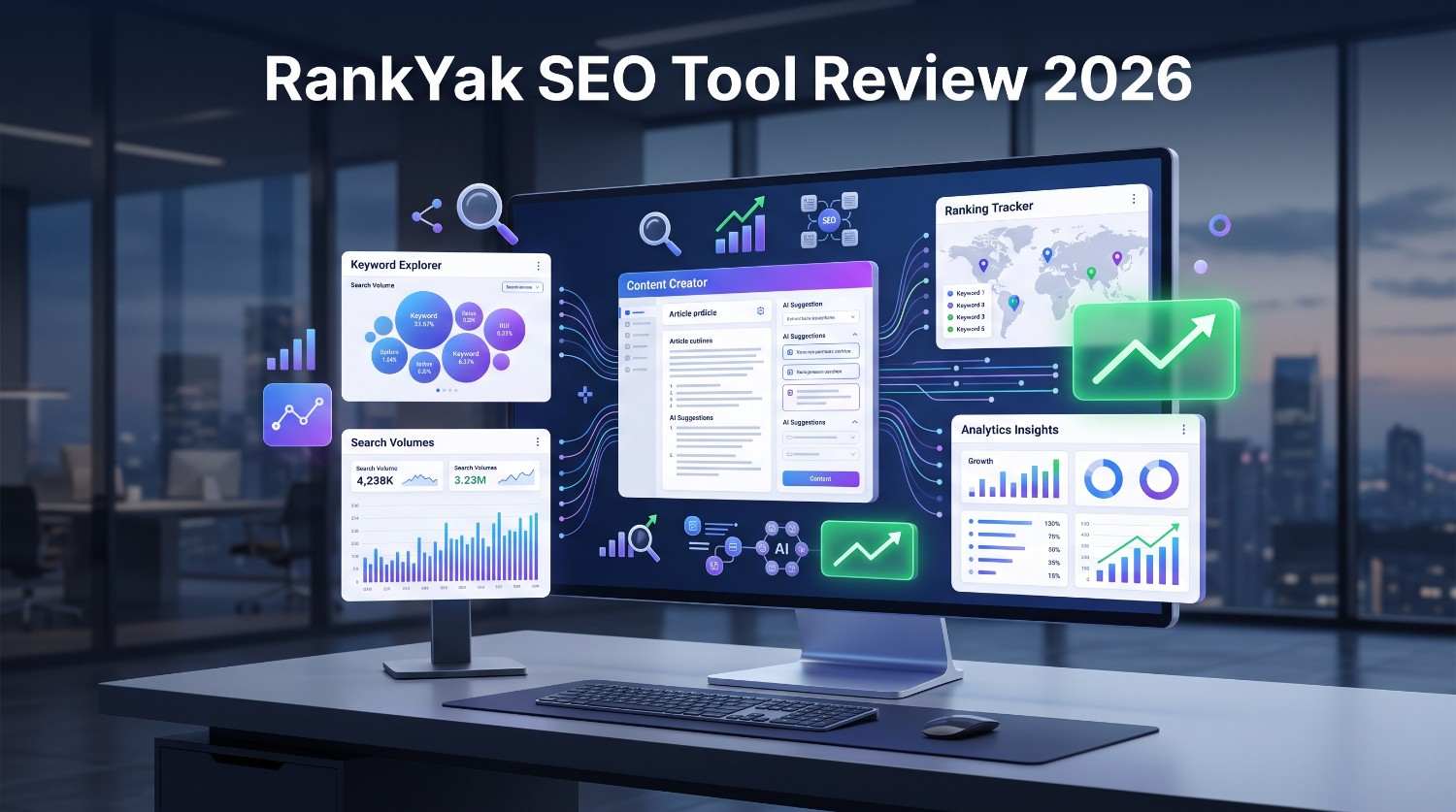
RankYak revolves around an interesting proposition: rather than offering you more SEO dashboards to analyze, it attempts to automate large chunks of the SEO workflow for you.
The platform performs keyword research, builds topic clusters, plans content, generates SEO-friendly articles including optimizing and publishing them to your website, refreshing underperforming content, and even participating in an automated backlink exchange. The RankYak SEO Tool is attracting attention from businesses seeking automation over the current ecosystem of multiple SEO tools.
The bigger question is whether this level of automation justifies $99 per website per month, and to what level you should retain human oversight.
This review looks at the current product in 2026, its main features and limitations, and how it compares with SEOWriting.ai, Surfer SEO, and Jasper.
What Is RankYak SEO Tool?
RankYak is an AI SEO automation platform that targets recurrent, content-led SEO tasks. Rather than being another keyword database or AI writer, RankYak joins several stages of SEO: research, topical planning, article generation, optimization, publishing, and backlink building.
According to the RankYak SEO Tool current documentation, keyword research is performed as long as a project is active, and keywords are clustered according to topics while being analyzed for volume and difficulty, and Google Search Console data can help avoid articles for terms an existing page already covers.
The platform is primarily aimed at websites that want to publish consistently: SaaS companies, agencies, ecommerce businesses, blogs, startups, local businesses, and smaller teams without a dedicated SEO content department.
The value proposition is therefore less about giving an SEO specialist more data, and more about reducing the amount of repetitive SEO execution that an individual would perform manually.
Read more seoservicehighsoftware99
How Does RankYak Work?
RankYak’s workflow starts with the website, rather than an empty AI writing prompt. After a website is set up within RankYak, the platform analyzes the niche and highlights search opportunities, with related queries grouped together so similar keywords can be covered by one page rather than having multiple competing articles.
RankYak then builds a monthly content plan, prioritizing opportunities using search volume and keyword difficulty, and scheduling content on the days you select. You can accept RankYak’s automated content plan, or manually move, remove, and replace keywords.
Before an article is created, the platform analyzes current ranking pages, performs search-intent research, examines structure and approximate length, and gathers related questions. The finished content can include structured headings, internal and external links, citations, metadata, images, and other supporting media.
Articles can then either be automatically published, or held as drafts for approval.
In other words, the workflow is: research → cluster → plan → write → optimize → publish → monitor → refresh.
That end-to-end workflow is the main reason for considering RankYak over a standalone AI writer.
RankYak SEO Tool Features Explained
AI Keyword Research
RankYak continuously discovers keywords relevant to your website’s niche, rather than requiring you to upload a spreadsheet before anything happens.
Keywords include volume and difficulty data and are grouped into topical clusters. Users can also upload up to 500 of their own keywords at once.
For smaller teams, this removes a substantial chunk of manual keyword sorting. Experienced SEOs will still wish to prioritize opportunities based on business value, conversion intent, SERP quality, and strategic priorities, rather than purely relying on RankYak’s opportunity scores.
Automated Content Planning
The content calendar turns keyword research into an actual publishing schedule.
RankYak can automatically select suitable keywords each month, while avoiding terms already covered by your rankings if Search Console is connected. The calendar is still editable, so automation doesn’t mean total loss of control.
This is especially useful for businesses that consistently perform keyword research but find it challenging to turn spreadsheets into regular publishing.
AI-Powered Article Creation
Article generation is more complex than simply typing in a keyword and requesting 2,000 words.
RankYak states that each article starts with live SERP research and search-intent analysis. Current plans support articles up to 5,000 words and can include citations, internal and external links, generated graphics, YouTube embeds, metadata, and brand-voice adaptation.
That provides users with a far stronger starting point than a generic AI-generated draft.
It shouldn’t be considered a total replacement for editorial judgment, however. Product claims, expert opinions, technical advice, YMYL content, original examples, and brand-specific insight should be reviewed or added by a knowledgeable human.
SEO Optimization Features
RankYak also offers optimization features following an article’s publication.
With Search Console connected, the system can identify RankYak articles that are underperforming, perform a fresh research pass, and update the article on the same URL, with revision history retained.
There is also Site Guard, which helps detect weak titles, descriptions, CTR issues, and keyword cannibalization. However, full Site Guard fixes are a separate paid add-on rather than part of the $99 subscription.
CMS Integration and Publishing
Publishing automation is one of RankYak’s strongest features.
It directly supports WordPress, WordPress.com, Shopify, Wix, and Webflow, with additional workflows available through Zapier, Make, RSS, webhooks, and a REST API. Articles can either be automatically published, or left as drafts until approval.
For teams managing a content calendar, removing the copy-paste-format-publish step can save meaningful operational time.
Backlink Automation
RankYak features a backlink exchange where participating websites are matched with relevant sites and contextual links are placed automatically inside articles.
This is interesting, but is equally the feature I would approach most carefully.
Google’s current spam policy lists excessive reciprocal link exchanges and automated services that primarily create links to influence rankings as forms of link spam.
That doesn’t mean every link created by RankYak automatically falls under these guidelines, but website owners should understand how links are selected, whether they are editorially justified, and how aggressively the exchange is being exploited, rather than treating automated backlinks as risk-free.
RankYak Pricing: Is It Worth the Cost?
RankYak Pro currently offers $99 per website per month.
Annual billing costs $990 per site, effectively $82.50 per month, as two months are free. The subscription includes keyword research, topical map, content planning, up to one article per enabled publishing day, publishing integrations, automatic RankYak article optimization, backlink exchange access, Copilot, REST API, and MCP access.
There is a three-day full-feature trial for one website, although RankYak requires a payment method to start it.
Site Guard costs an additional $99 per website per month if you want its full auditing and suggested-fix functionality.
For one site consistently publishing 20-30 articles a month, $99 can be reasonable. For agencies managing many domains, per-site pricing becomes considerably more important, although RankYak currently applies automatic volume discounts starting at three active projects.
RankYak Pros and Cons
Advantages
Combines keyword research, planning, writing, publishing, and content refreshing.
Requires much less workflow management than a typical SEO software stack.
Uses live SERP research before article generation.
Supports automatic or approval-based publishing.
Includes internal linking, citations, visuals, metadata, and brand voice.
Strong CMS and automation integrations.
Particularly useful for consistent content production.
Limitations
$99 is charged per website.
Site Guard requires another $99 per site.
AI content still requires fact-checking and editorial review.
Not a replacement for comprehensive technical SEO, CRO, digital PR, or business strategy.
Daily content generation is unnecessary for some websites.
Automated backlink exchange should be carefully risk-assessed.
Maximum automation can become a weakness without reviewing what is being published.
RankYak vs Other AI SEO Tools
| Tool | Main Strength | Automation Level | Best For |
|---|---|---|---|
| RankYak | End-to-end SEO content workflow | Very high | Hands-off content-led SEO |
| SEOWriting.ai | High-volume AI article creation | High for content | Bulk publishers and affiliate sites |
| Surfer SEO | SERP-driven content optimization | Medium | SEOs wanting granular optimization control |
| Jasper AI | Brand-focused marketing content | Medium | Marketing teams producing multiple content formats |
RankYak vs SEOWriting.ai
SEOWriting.ai is particularly strong at bulk article generation and WordPress publishing, including batches of content, whereas RankYak places more emphasis on automatically deciding what should be written via its keyword and topical-planning workflow.
RankYak vs Surfer SEO
Surfer gives writers and SEOs more hands-on control over optimization, Content Scores, topical maps, auditing, and SERP-based editing. Its current annual plans start at $49 per month, with higher levels adding more capacity and features. RankYak makes more sense when reducing manual intervention is the priority.
RankYak vs Jasper
Jasper is a broader marketing software rather than a dedicated autonomous SEO pipeline. Jasper Pro currently costs $69 monthly or $59 per month with annual billing and focuses heavily on brand voice, marketing workflows, agents, and campaign content.
Who Should Use RankYak?
RankYak is most compelling for businesses where consistency is the bottleneck.
Agencies can utilize it to standardize content production across their sites. SaaS companies can create informational clusters within their market. Bloggers can maintain a consistent publishing schedule, while small businesses without SEO staff can automate tasks they would typically neglect.
It is also a strong fit for founders that have enough understanding of SEO to evaluate strategy and output, but without wishing to spend several hours a week executing it.
Who Should Avoid RankYak?
RankYak is less attractive if you only publish a few highly researched articles a year.
It is also not the ideal choice if your SEO strategy relies heavily on original research, specialist expert commentary, investigation content, sophisticated technical SEO, or extremely tight editorial control.
Businesses in sensitive niches should be particularly careful about publishing AI-generated content without subject-matter review.
Is RankYak SEO Tool Worth It in 2026?
For the right website, yes, but mostly due to the workflow automation, rather than just AI writing.
There are cheaper AI writers and more advanced standalone SEO platforms. RankYak’s strength is connecting the pieces and keeping the content engine running after the initial setup.
Its $99 monthly cost becomes far more reasonable when it replaces several recurring tasks: keyword discovery, content planning, drafting, internal linking, optimization, and CMS publishing.
I wouldn’t take it as a totally unsupervised replacement for an experienced SEO professional, but rather let RankYak automate the repetitive execution, and have a human oversee strategy, accuracy, differentiation, commercial intent, and quality.
That’s where the platform has its real value.
Frequently Asked Questions
What is RankYak SEO Tool used for?
RankYak automates keyword research, topical planning, SEO article generation, content publishing, article refreshing, and backlink exchange management.
Does RankYak create SEO-friendly articles?
Yes. Its current workflow includes SERP research, search-intent analysis, structured headings, metadata, internal and external links, citations, and visuals.
Can RankYak replace an SEO agency?
Not completely. It can replace or reduce some of the repetitive content-production tasks, but technical SEO, strategic decision-making, digital PR, conversion optimization, and expert editorial work may require specialists.
Is RankYak good for beginners?
It can be. Much of the workflow is automated, although beginners should still learn basic SEO principles so they can evaluate the keywords, articles, and links that RankYak produces.
How much does RankYak cost?
RankYak Pro costs $99 per website per month or $990 annually. Site Guard is an optional additional $99 per website per month.
Does RankYak help websites rank higher?
RankYak provides tools designed to improve SEO execution, but no software can guarantee rankings. Search performance still depends on competition, website authority, content quality, technical health, relevance, links, and other factors.
Can RankYak publish articles automatically?
Yes. It supports direct CMS integrations and can automatically publish finished articles, or hold them as drafts for approval.
Is RankYak better than Surfer SEO?
Neither is universally better. RankYak is better suited to users who prioritize end-to-end automation, whereas Surfer is better for teams that want detailed, hands-on SERP-driven content optimization and control.
You may also like
1 thought on “RankYak SEO Tool Review 2026 Features, Pricing, Pros, Cons & Alternatives”