Direct Answer
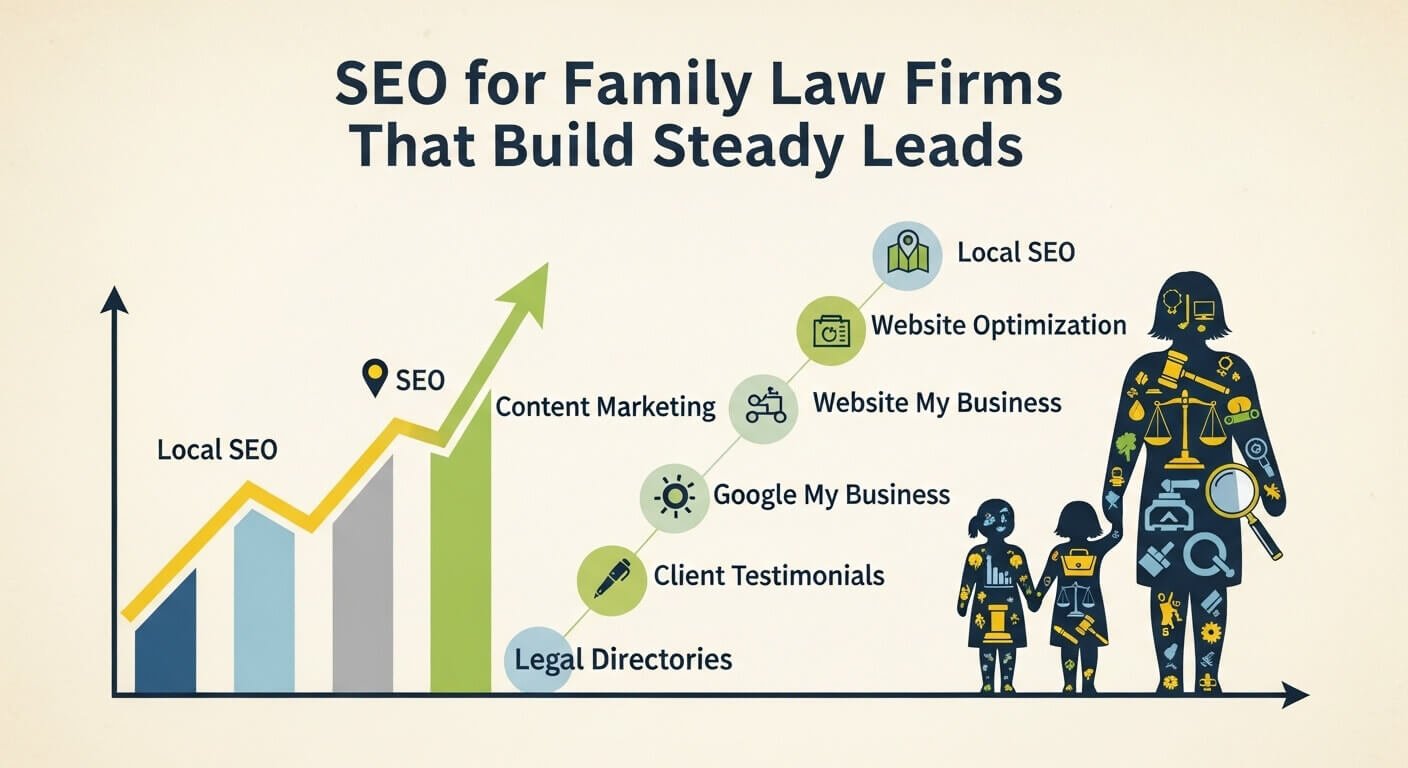
SEO for family law is the practice of optimizing a family law firm’s website to appear in Google search results when potential clients search for legal help with divorce, child custody, domestic violence, alimony, adoption, and related family legal matters. Because family law falls under Google’s YMYL (Your Money or Your Life) category, it carries the highest E-E-A-T requirements in SEO — only content that demonstrates genuine legal expertise, verifiable attorney credentials, and authoritative trustworthiness will consistently rank. Family law SEO combines local search optimization, practice area content, attorney profile building, and increasingly, AI search visibility for queries answered by ChatGPT and Google AI Overviews.
Why Family Law SEO Is Different from Standard Local SEO

Legal SEO is different because the user’s stakes are different. Someone searching for a family lawyer is often dealing with risk, urgency, and uncertainty. The content they find can affect real decisions about money, safety, rights, and long-term outcomes. Google’s broader quality framework applies higher scrutiny to YMYL topics precisely because inaccurate or low-quality information in these areas can cause meaningful harm.
This matters practically because Google holds family law content to a higher standard than, say, a plumber’s website. Generic content — “we handle divorce cases with compassion” — doesn’t rank. Neither does AI-generated content that reads like it was written by someone who has never seen the inside of a courtroom. What ranks is content that demonstrates the specific, experiential expertise of a real attorney who understands the nuances of family law in their jurisdiction.
This creates both a challenge and an opportunity. The challenge: you can’t cut corners on content quality. The opportunity: most family law firms are cutting corners, which means genuine expertise expressed clearly online is a significant competitive advantage.
The YMYL and E-E-A-T Requirements for Family Law
Google’s E-E-A-T framework (Experience, Expertise, Authoritativeness, Trustworthiness) applies to all content, but the threshold for YMYL topics like family law is materially higher. Here’s what each component requires specifically for family law SEO:
- Experience means demonstrating first-hand professional experience with the cases you handle. Not just “we handle custody disputes” — but specific discussion of how custody evaluations work in your state, what factors judges consider, and what clients should expect from the process. This level of specificity can only come from an attorney who has actually handled these cases.
- Expertise means your attorneys’ credentials are clearly visible and verifiable. Law firm websites must demonstrate that real attorneys are behind the content. This includes strong attorney bios, bar admissions, credentials, awards, case involvement, publications, and cross-platform citations. If your attorney bios consist of a headshot and two sentences, you are failing the expertise signal for every page on your site.
- Authoritativeness means your firm is recognized by other credible sources. Bar association membership pages, legal directory listings (Avvo, FindLaw, Justia), local bar association resources, and mentions in local legal publications all build authority signals. These aren’t optional extras — for family law SEO, they’re foundational.
- Trustworthiness for a law firm means: HTTPS security, a clear privacy policy, transparent contact information including physical office address, genuine client reviews, and no misleading claims about outcomes. Especially important: state bar advertising rules require family lawyers to maintain ethical compliance. This means your SEO strategy must balance aggressive optimization with professional responsibility standards. Include appropriate disclaimers about attorney-client relationships and document the basis for any statistical claims about success rates.
Local SEO for Family Law Firms
The vast majority of family law searches are local. People don’t search “best divorce attorney in America” — they search “divorce lawyer [city]” or “child custody attorney near me.” This means local SEO, specifically Google Business Profile optimization, is the highest-leverage activity for most family law practices.
For most practice areas, including family law, Google treats GBP as a core trust signal. A strong profile includes accurate NAP information, correct practice categories, business hours, a compelling description, photos, and consistent citations across the web. Law firms that update their profile weekly tend to outperform those that leave it untouched
For family law specifically, your Google Business Profile category should be “Family Law Attorney” as the primary category, with secondary categories for specific practice areas relevant to your firm. The description should include your specific geographic service area and your primary practice focuses — not generic language that could describe any law firm.
Reviews are especially important for family law because potential clients are making a high-stakes, emotionally charged decision. Completion of your Google Business Profile with all important details like categories, services, and NAP is foundational. At the same time, monitoring who links to top-performing family law firms in your area gives you ideas for new sources of backlinks. A firm with 80 reviews averaging 4.8 stars will consistently outrank a technically superior website with 12 reviews.
Practice Area Pages: The Core Content Strategy
Each legal practice area should have a dedicated, SEO-optimized page. This is one of the most straightforward but consistently neglected areas of family law firm websites. Most firms have a single “Family Law” services page. Top-ranking firms have individual pages for:
- Divorce attorney/divorce lawyer [city]
- Child custody attorney [city]
- Child support lawyer [city]
- Spousal support/alimony attorney [city]
- Domestic violence restraining orders [city]
- Property division lawyer [city]
- Adoption attorney [city]
- Prenuptial agreement lawyer [city]
- Grandparents’ rights attorney [city]
Each page should be 800–1,500 words covering: what this legal matter involves in your jurisdiction, how the process works, what factors courts consider, what clients should bring to the first consultation, and a clear path to contact the firm. This is genuine informational value, not keyword stuffing. It’s also exactly what potential clients need before they’re ready to pick up the phone — and it’s what earns rankings.
Content Strategy: Capturing Clients Earlier in Their Journey
Create content for every stage of the journey, including early-stage pages like “is my marriage over” or “what are my child custody options” that do not push for an immediate consultation. Build tools like alimony calculators and child support estimators that add genuine value. Firms that build valuable educational content find that clients who engage with it over time have higher show-up rates and closing rates because the trust is already established before the first intake call.
This insight changes the entire content strategy for family law SEO. Most people searching for family law information are weeks or months away from hiring an attorney. They’re in research mode. The firm that provides genuinely helpful, trustworthy answers during that research phase is the one they’ll call when they’re ready.
Effective educational content for family law includes:
- How divorce works in [state] — step-by-step guide
- What is the difference between legal separation and divorce?
- How is child custody determined in [state]?
- What can I do if my ex violates a custody order?
- How much does a divorce cost in [state]?
- Can I get a divorce without a lawyer?
Each of these is a real question people search. Each represents a potential client. Each is an opportunity to demonstrate expertise and build trust before any money changes hands.
Family Law SEO and AI Search
AI platforms pull recommendations from the same sources that power traditional search. They reference Google Maps rankings, website authority, and content quality to generate answers.
When users ask ChatGPT, “how do I get full custody of my child,” or ask Google AI, “what are my rights in a divorce in [state],” these systems cite authoritative, well-structured legal content. Family law firms that apply AEO formatting — direct answer boxes, FAQ schema, clear definitions — are increasingly appearing in AI-generated answers that reach users before they ever reach a traditional Google search result.
HighSoftware99.com’s GEO and AEO optimization service ensures family law content is structured for AI citation, not just traditional ranking. This is a meaningful competitive advantage in a category where most firms have no AI search presence at all.
How Long Does Family Law SEO Take?
For hyperlocal searches (“divorce lawyer [small city]”) in lower-competition markets, page 1 rankings typically appear within 3–4 months of proper optimization. For competitive urban markets (“divorce attorney Los Angeles,” “family lawyer London”), realistic timelines are 6–12 months for sustained page 1 positions. The investment compounds — a well-built family law SEO foundation generates leads for years, without ongoing ad spend.
Unlike Google Ads, where the average law firm spends $9,000 to $10,000 per month according to industry surveys, organic SEO efforts compound over time. Family law is one of the highest-value SEO investments available — a single retained client often generates $3,000–$20,000+ in legal fees, making even a conservative organic traffic increase highly profitable.
Frequently Asked Questions About SEO for Family Law
What is SEO for family law?
SEO for family law is the practice of optimizing a family law firm’s website to rank in Google’s search results for queries related to divorce, child custody, alimony, adoption, domestic violence, and related family legal matters. It includes local SEO (Google Business Profile optimization, map pack rankings), practice area content, attorney E-E-A-T signals, and increasingly, AI search optimization for ChatGPT and Google AI Overviews.
Why is family law SEO harder than regular local SEO?
Family law is a YMYL (Your Money or Your Life) category, which means Google applies higher quality scrutiny to family law content than it does to, say, a pizza restaurant. Content must demonstrate genuine legal expertise, verified attorney credentials, and authoritative sourcing. Generic or AI-generated content without real legal expertise consistently fails to rank in this category.
What content does a family law firm need for SEO?
At minimum: separate practice area pages for each service (divorce, custody, support, etc.) with city-specific targeting; strong attorney bio pages with credentials, bar membership, and case experience; an educational blog covering common questions clients ask before hiring; and a Google Business Profile that is fully completed and actively maintained with recent reviews.
How much does SEO cost for a family law firm?
Family law SEO typically costs $1,000–$3,000/month for a professional service in competitive markets. Budget under $500/month rarely delivers meaningful results for a YMYL legal category. HighSoftware99.com’s Growth plan at $1,199/month includes the content, technical, and AI visibility work required for competitive family law SEO.
Do family law firm reviews really affect rankings?
Yes, significantly. Review volume, recency, average rating, and response rate are all direct local ranking signals for Google Business Profile positions. A family law firm with 100 recent reviews at 4.8 stars will consistently outrank a firm with better website optimization but only 15 older reviews. Building a systematic, ethical review generation process is one of the highest-ROI activities in family law SEO.