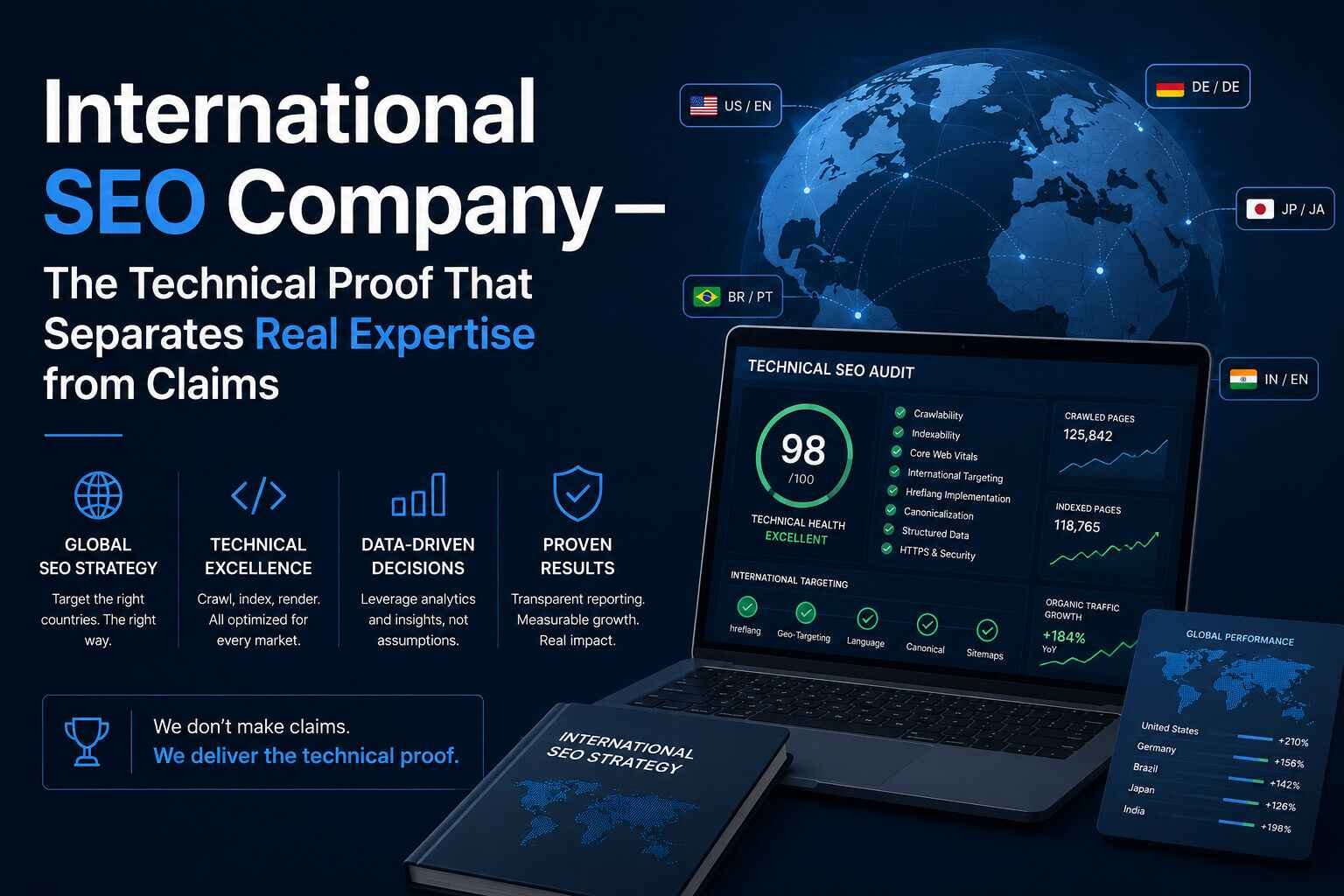
Most international SEO companies won’t tell you: approximately 80% of agencies that claim international SEO capability are running hreflang through a translation plugin and hoping Google figures it out.
Hreflang errors are the most common and most damaging technical failure in international SEO. They’re invisible to the naked eye, undetectable without specialist tools. When they’re wrong — which they frequently are — they either cause Google to show the wrong language version of your site to users in the wrong country or suppress your new market pages from ranking entirely.
This guide explains what a genuine international SEO company does, which technical questions separate real expertise from claimed expertise, and what results look like with realistic timelines.
What Genuinely Separates International SEO Companies
The difference between a domestic SEO agency and a genuine international SEO company isn’t the number of country flags on their website. It’s three specific capabilities.
- Market-native keyword research: Translating your existing keywords into a target language is not keyword research. It produces content targeting terms that native speakers of that language don’t actually search. A genuine international SEO company conducts independent keyword research in each target market — using that market’s tools, that market’s search data, and ideally speakers with native knowledge of how users in that country phrase their searches.
- Hreflang architecture that works: Hreflang implementation has a specific set of technical requirements. Every language or country variant of a page must reference all other variants. The x-default tag must point to the fallback URL for users whose language doesn’t match any variant. All hreflang URLs must return 200 status codes — not redirects, not 404s. A single misconfiguration causes the entire implementation to fail silently, with no error message and no obvious symptoms until you notice that organic traffic from your target market isn’t appearing.
- Country-specific link building: A UK-facing German page backed entirely by English-language links will struggle to rank in German search results. Authority signals in each country’s search ecosystem come from that country’s websites. An international SEO company has the outreach infrastructure and market relationships to acquire links from German publishers, French trade associations, and Spanish-language industry directories — not just English-language domains.
The URL Structure Decision You Can’t Easily Undo
International URL structure — the choice between ccTLDs, subdirectories, and subdomains — is the most consequential architectural decision in international SEO. Get it right initially, and scaling is straightforward. Change it later, and you spend months in redirect management and authority recovery.
- ccTLDs (site.de, site.fr): Strongest geo-targeting signal Google offers. Google treats each as a separate domain, which means you build a separate domain authority from scratch in every market. Right for large brands with dedicated country teams and multi-year commitments.
- Subdirectories (site.com/de/, site.com/fr/): Consolidates all link equity under one domain. Google supports precise geo-targeting via Search Console targeting settings. Easier to manage in a single CMS. The right choice for most businesses expanding internationally.
- Subdomains (de.site.com, fr.site.com): A middle ground that partially fragments authority. Technically feasible, but rarely the optimal choice compared to subdirectories.
A genuine international SEO company explains this trade-off in the context of your specific business — not as a generic preference for one structure over another.
The Expensive Mistake: Translation Without Localization
Translation produces text that your new market can technically read. Localization produces content that sounds like it was written for that market.
The difference is measurable in rankings. Translated content uses the wrong vocabulary, misses the idiomatic search queries native users type, lacks the cultural references that build trust, and often preserves sentence structures natural to English but awkward in the target language. Search engines understand semantic patterns within languages, not just word matching. Content that feels translated — even when it’s technically accurate — ranks below content written natively.
The practical requirement: either employ native-language writers and SEO specialists in each target market, or build verified partnerships with them. Any international SEO company that doesn’t have documented native-language content capability for its target markets is selling you translation, not localization.
How to Verify an International SEO Company’s Actual Capability
Three questions immediately differentiate answers:
“Walk me through how you’d set up hreflang for a site targeting US English, UK English, and German users.” The correct answer mentions the bidirectional requirement, the x-default tag, the distinction between language-only (hreflang=”de”) and language-country (hreflang=”de-de”) targeting, and how they validate implementation post-launch. An incorrect or incomplete answer is disqualifying.
“For a market where you don’t have native speakers on staff, how do you conduct keyword research?” They should name specific tools, partnerships, or processes. “We use Google Translate and then do keyword research” is the wrong answer.
“Can you show me organic traffic growth in a specific non-English market?” Not overall traffic. Not English-language international traffic. Specifically, a non-English market where they built rankings from a low base. This evidence separates international SEO companies from domestic agencies with international brochures.
Realistic International SEO Timeline
Technical configurations — hreflang, URL structure, Search Console geo-targeting — are picked up by Google within days to two weeks. Rankings in new markets take longer.
In low-competition niches, entering markets with few established local competitors: 2–3 months for initial rankings. In competitive professional services, e-commerce, or SaaS categories entering mature markets like Germany or France, 6–12 months for meaningful organic traffic from the new market. Building authority in a new country is identical to building authority from scratch domestically — the timeline reflects that reality.
Frequently Asked Questions
What does an international SEO company do?
An international SEO company designs and executes search optimization for businesses targeting multiple countries. Core deliverables: international URL architecture, hreflang implementation and ongoing validation, market-native keyword research in each target language, localized content production, country-specific link building, and cross-market analytics. The critical distinction from domestic agencies is genuine market expertise in each target country, not translation of existing content.
How do I know if an agency actually understands international SEO?
Ask specific technical questions about hreflang implementation — the bidirectional requirement, the x-default tag, and how they handle hreflang on paginated pages. Ask for evidence of organic traffic growth in specific non-English markets they’ve managed. Vague or incomplete answers reveal agencies applying domestic frameworks to international problems.
Should I use ccTLDs or subdirectories?
Subdirectories are the right choice for most businesses. They consolidate domain authority, simplify management, and are fully supported by Google’s geo-targeting tools. ccTLDs provide marginally stronger geo-targeting but require building independent domain authority from scratch in every market — only worthwhile for large enterprises with dedicated country teams.
How much does an international SEO company cost?
Ongoing international campaigns covering 2–3 markets typically cost $2,000–$6,000/month at professional rates. Single-market entry audits and strategy projects run $1,500–$4,000. HighSoftware99.com covers English-language international campaigns in the Growth plan at $1,199/month.
What’s the most common international SEO mistake?
Treating translation as localization. Translated content misses the vocabulary, phrasing patterns, and search intent signals of native-language users. Rankings in non-English markets require content written for that market’s search behavior, not English content converted to another language.
Three things to take away: The hreflang bidirectional requirement disqualifies more agencies than any other technical factor. URL structure is an irreversible decision that should be made before any content is built. Translation and localization are different capabilities — verify which one you’re actually being offered.
Next step: if you’re planning international expansion, start with a market entry audit — competitive analysis, keyword research, and authority assessment for each target country — before committing to any content or technical work. The audit prevents the expensive mistake of investing in a market where the competitive barrier is too high for your current domain authority.