Direct Answer
Amazon SEO services are professional optimization services that improve a product listing’s visibility in Amazon’s internal search results. A significant percentage of consumers begin their product searches directly on Amazon — not Google. When someone types a query into the Amazon search box, they’re not browsing. They’re buying. Amazon SEO covers product title optimization, backend keyword fields, bullet points, product descriptions, A+ Content, image strategy, and the conversion and sales velocity signals that Amazon’s algorithm uses to determine ranking. The goal is to appear on page one of Amazon’s organic search results for the keywords your target buyers use — without paying for every click through Sponsored Ads.
How Amazon SEO Differs from Google SEO
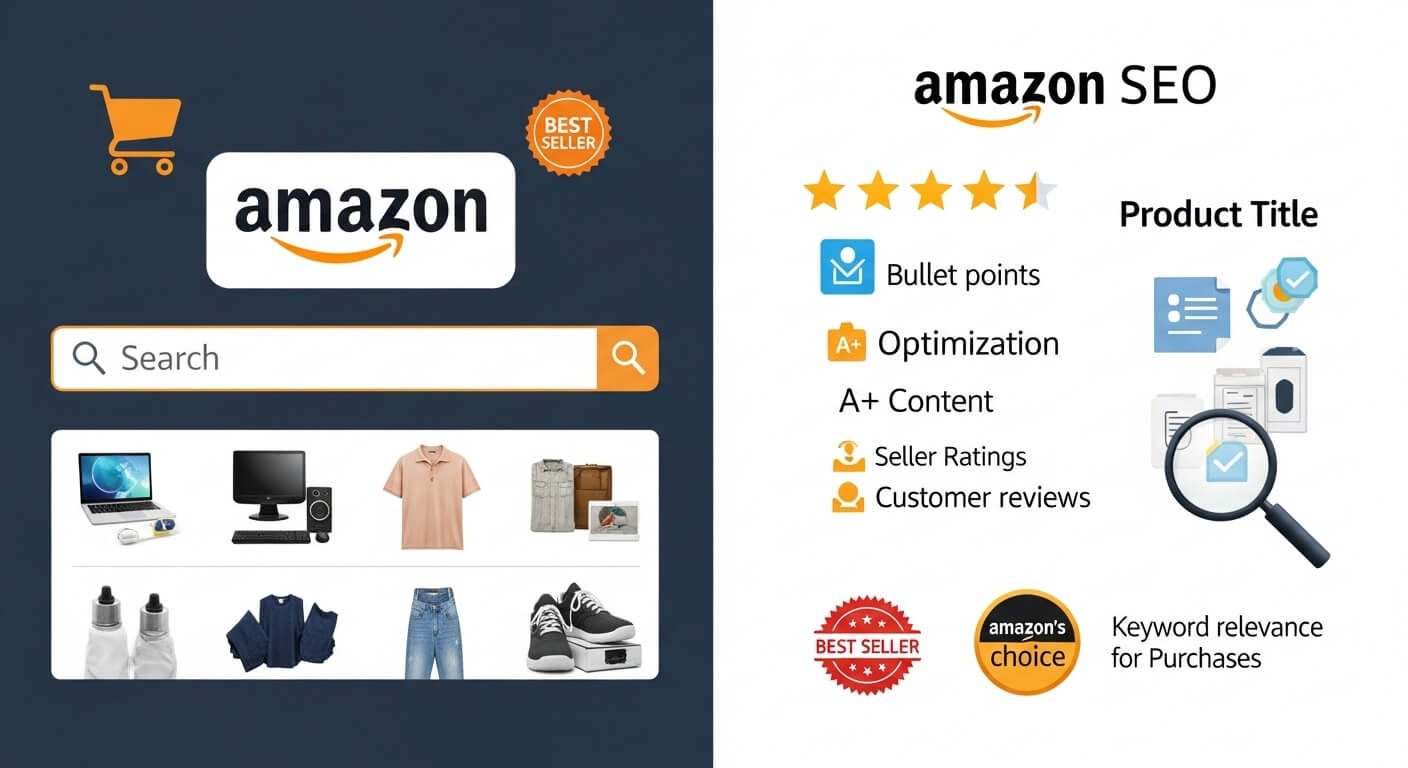
Understanding what makes Amazon SEO distinct from Google SEO is essential before investing in either. The two systems share some principles but operate on fundamentally different logic.
- Google’s primary goal is to surface the most relevant, authoritative, helpful information for a searcher’s query. Authority signals (links, E-E-A-T, domain history) carry significant weight alongside content relevance.
- Amazon’s primary goal is to sell products. Amazon’s organic search and ranking logic rewards matching the right product to the right query and outperforming competing offers once shoppers arrive. You’re optimizing for relevance, click-through rate, conversion rate, inventory reliability, pricing competitiveness, review strength, and the quality of the offer as a whole.
This means Amazon SEO is much more tightly tied to commercial performance than Google SEO. A product that ranks on page 1 of Amazon and converts poorly will lose its rankings. A product that ranks on page 1 and converts well will continue to climb. The algorithm is self-reinforcing in a way that Google’s is not — sales create rankings, and rankings create more sales.
What Amazon SEO Services Include
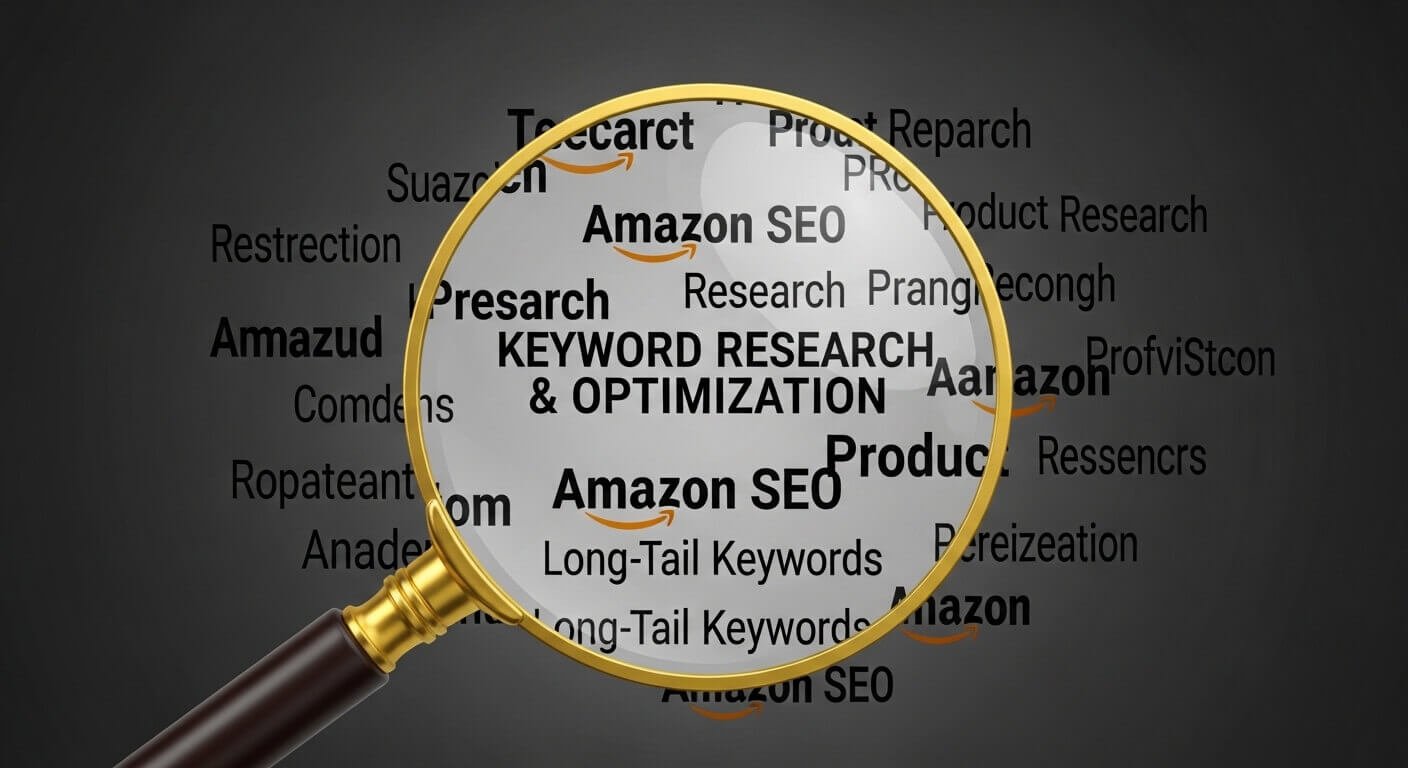
Keyword research for Amazon
Amazon keyword research differs from Google keyword research in one critical way: Amazon’s data is proprietary. You can’t see Amazon search volumes in Google Keyword Planner. Amazon SEO services use specialized tools — Helium 10, Jungle Scout, and DataDive — to extract keyword data from Amazon’s search suggest, Brand Analytics (for registered brands), and competitor listing analysis.
Prioritize high-conversion keywords — focus on keywords with a high conversion rate, as these are more likely to drive sales and improve ranking. Balance sales volume and competition: select keywords that offer a balance between sales volume and competition. Ensure relevance: only choose keywords directly related to your product.
The research output is a prioritized keyword list with separate strategies for: primary keywords (in the product title, maximum visibility), secondary keywords (in bullet points and description), and backend search terms (hidden from buyers, indexed by Amazon’s algorithm).
Product title optimization
The product title is Amazon’s most important ranking field. Tightening your product title with the right keywords is one of the highest-impact changes you can make for ranking improvement. A well-structured Amazon product title includes: brand name, primary keyword, key product attributes (size, material, count), and the most critical use case or differentiation. Title optimization requires balancing keyword inclusion with readability — Amazon’s algorithm values title relevance, but buyers also need to understand what the product is from the title alone.
Backend keyword fields
Filling your backend keywords is one of the four changes that can move you from page 3 to page 1. Backend keywords are terms indexed by Amazon but not visible to shoppers. They’re the place for: spelling variations, synonyms, colloquial terms your target buyers use, related but secondary keywords that don’t fit naturally in the visible listing, and competitor brand terms where relevant. A professional Amazon SEO service fills every character of available backend keyword space with strategically chosen terms.
Bullet points and product description
Bullet points serve two audiences: Amazon’s algorithm and the buyer. For the algorithm, they need to include secondary and tertiary keywords in natural phrasing. For the buyer, they need to answer the questions that determine purchase decisions: what problem does this solve, what makes it better than alternatives, what specifications matter, and what do reviews say about common concerns.
Listings that align with real shopper needs rank higher, rewarding detailed, helpful content and external validation. Generic manufacturer bullet points that could apply to any similar product perform significantly worse than listing-specific content tailored to the actual questions buyers have about that particular product.
A+ Content (Enhanced Brand Content)
Available to brand-registered sellers, A+ Content replaces the standard product description with rich visual modules — comparison charts, feature callouts, brand story sections, and cross-selling galleries. A+ Content boosts conversions and also supports SEO by improving time spent on the page. Amazon SEO services design and optimize A+ Content modules for both visual conversion and keyword signal reinforcement.
Image optimization
Amazon lets you upload up to seven images — use all of them. Good images equal more conversions, which equals better rankings. Amazon SEO services audit image quality (minimum 1,000 pixels on the shortest side for zoom functionality), ensure the main image meets Amazon’s white background requirement, and structure the supporting images to answer buyer questions: product in use, size comparison, feature callouts, materials close-up, and packaging.
The Conversion-Ranking Feedback Loop
This is the most important concept in Amazon SEO, and the one most sellers underestimate. Amazon’s algorithm is explicit: products that convert well get ranked higher, which gives them more visibility, which generates more sales, which reinforces their rankings.
If your rankings disappear the moment you reduce ad spend, you do not have SEO. You have rented visibility. In contrast, robust Amazon SEO gives you lasting, structural control and defensible market positions.
Building organic rankings on Amazon requires: enough sales velocity to signal relevance to Amazon’s algorithm for target keywords, a conversion rate that matches or exceeds category averages, competitive pricing that doesn’t suppress conversion, and review volume sufficient to build buyer confidence.
Amazon SEO services address the listing-side factors (content, images, keywords) that drive click-through rate and conversion. They cannot guarantee external factors — pricing strategy, product quality, inventory management — but they ensure the listing itself is not the limiting factor in your conversion rate.
External Traffic: The Accelerator for Amazon Rankings
The most significant ranking factor in 2026 is your ability to drive high-quality external traffic that converts on Amazon. Sellers who successfully bring qualified visitors from Google, social media, and influencer partnerships see dramatic ranking improvements.
Amazon heavily rewards external traffic that converts because it represents incremental sales that Amazon’s own algorithm didn’t generate. This creates an opportunity: businesses with existing SEO presence (Google rankings, email lists, social followings) can amplify their Amazon rankings by driving that existing traffic to Amazon listings.
HighSoftware99.com’s Amazon SEO service includes an external traffic strategy for clients who want to accelerate organic Amazon rankings through coordinated Google SEO and Amazon listing optimization.
What Amazon SEO Services Cost
Amazon SEO services are typically priced in one of three ways:
- One-time listing audit and optimization ($300–$1,500 per ASIN): A professional review and rewrite of a product listing with keyword research included. Appropriate for sellers with a small catalog who want expert optimization without an ongoing relationship.
- Catalog audit and strategy ($1,500–$5,000 project): Analysis of the full product catalog, keyword gap identification, prioritized optimization roadmap, and implementation of high-impact fixes across all listings.
- Monthly retainer ($800–$3,500/month): Ongoing optimization, A/B testing of listing elements, review management, competitive monitoring, and adaptation to Amazon algorithm changes. Appropriate for sellers with significant Amazon revenue where ongoing optimization delivers compounding returns.
The $15 average CPC for “amazon seo services” signals strong commercial intent — businesses searching this term are actively considering professional help and typically managing meaningful Amazon revenue.
Frequently Asked Questions About Amazon SEO Services
What are Amazon SEO services?
Amazon SEO services optimize product listings to rank higher in Amazon’s internal search results. Services include keyword research using Amazon-specific tools, product title optimization, backend keyword field completion, bullet point and description optimization, A+ Content design, image audit, and external traffic strategy. The goal is organic visibility in Amazon search results that generates consistent sales without reliance on Sponsored Ads.
How is Amazon SEO different from Google SEO?
Amazon’s algorithm prioritizes commercial performance signals — conversion rate, sales velocity, review volume, pricing competitiveness — alongside keyword relevance. Google prioritizes content authority, E-E-A-T signals, and user intent matching. Amazon SEO is more tightly tied to direct sales outcomes; a listing that converts poorly loses rankings regardless of keyword optimization quality.
How much do Amazon SEO services cost?
One-time listing optimization runs $300–$1,500 per product. Full catalog audits run $1,500–$5,000 as projects. Monthly retainers for ongoing Amazon SEO optimization run $800–$3,500/month. Given that the average Amazon product page 1 position is worth 3–10x more traffic than page 2, professional optimization typically pays for itself within 2–4 months of improved rankings.
How long does Amazon SEO take to work?
Keyword-relevant listing changes are crawled and indexed by Amazon within 24–72 hours. Ranking improvements from optimization appear within 1–4 weeks for most products. Products that require sales velocity building — new listings or products recovering from poor performance — take 4–8 weeks of sustained sales activity alongside listing optimization before rankings stabilize.
Does external traffic help Amazon rankings?
Yes, significantly. Amazon explicitly rewards sellers who drive external traffic (from Google, social media, email, influencers) that converts on Amazon. This external traffic signal tells Amazon your product is in demand beyond the marketplace, which improves algorithmic rankings. Sellers who combine strong listing optimization with coordinated external traffic strategies see faster and more durable ranking improvements than those using listing optimization alone.