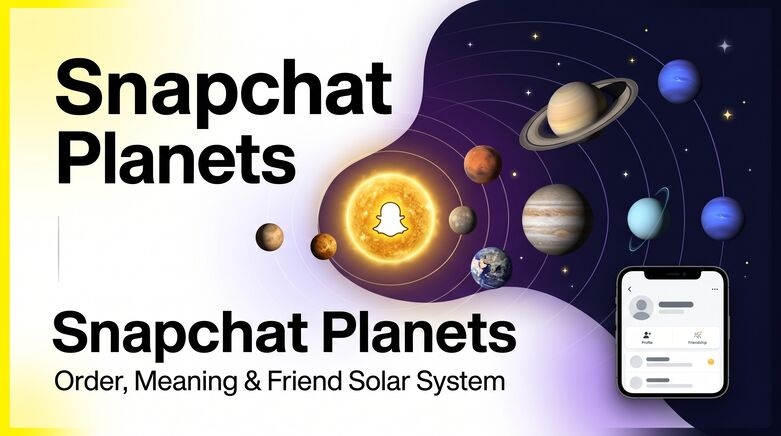
Snapchat Planets are a visual representation of your closest friendships on Snapchat, available through the Snapchat+ subscription. The feature, officially called the Friend Solar System, assigns an astronomical planet to each of a user’s top eight Best Friends based on how frequently they communicate. If you are someone’s #1 Best Friend, you appear as Mercury in their solar system. If you are their eighth Best Friend, you appear as Neptune.
What Are Snapchat Planets?
Snapchat Planets belong to the Friend Solar System, an exclusive feature designed for Snapchat+ subscribers. The concept uses our actual solar system as a metaphor for friendship hierarchy. In this setup, the profile owner acts as the Sun at the center. The eight friends they interact with the most their official Best Friends list—revolve around them as the eight classical planets.
The closer a planet’s real-world orbit is to the Sun, the higher that friend ranks on the user’s Best Friends list. The feature does not create a public leaderboard for everyone to browse. Instead, it allows a subscriber to check individual Friendship Profiles to see where they stand relative to another person’s top circle.
Snapchat Planets Order and Meaning
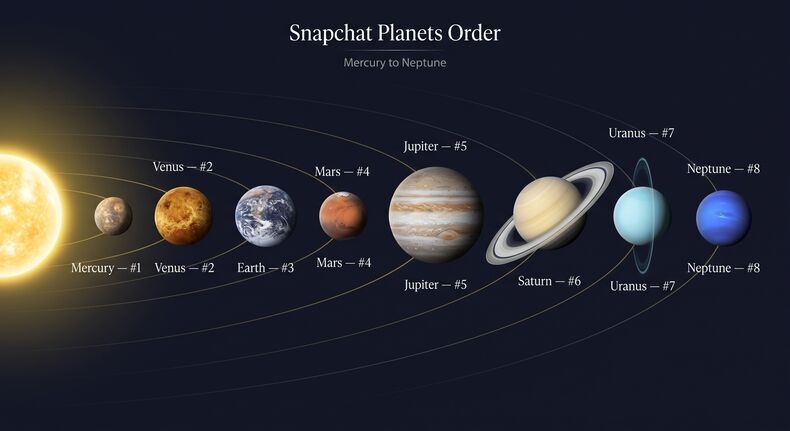
The order of planets on Snapchat follows the exact scientific order of the solar system, starting with the closest orbit to the Sun and moving outward to the eighth position.
| Rank | Planet | Meaning |
| #1 | Mercury | Closest / highest-ranked Best Friend |
| #2 | Venus | Second-closest Best Friend |
| #3 | Earth | Third-closest Best Friend |
| #4 | Mars | Fourth-closest Best Friend |
| #5 | Jupiter | Fifth-closest Best Friend |
| #6 | Saturn | Sixth-closest Best Friend |
| #7 | Uranus | Seventh-closest Best Friend |
| #8 | Neptune | Eighth-closest Best Friend |
Mercury – #1 Best Friend
Mercury represents the person you message and snap the most. In the app, Mercury is illustrated as a reddish planet surrounded by red hearts. Being Mercury means you hold the top spot in that user’s Best Friends list.
Venus – #2 Best Friend
Venus holds the second spot. It appears as a light-brown or yellowish planet with pink and yellow hearts drifting around it. This position indicates that you are their second most frequent contact on the platform.
Earth – #3 Best Friend
Earth corresponds to the third position. The icon displays the familiar green-and-blue globe accompanied by red hearts and a small white moon. It marks the third rank in a user’s friendship circle.
Mars – #4 Best Friend
Mars represents the fourth-ranked friend. It is rendered as a reddish-orange planet surrounded by purple and blue stars. Reaching Mars means you are firmly in their top half of Best Friends.
Jupiter – #5 Best Friend
Jupiter occupies the fifth position. It is shown as a large, reddish-orange striped planet decorated with yellow and blue stars. This rank places you just past the midway mark of their top eight.
Saturn – #6 Best Friend
Saturn holds the sixth spot. It is instantly recognizable by its yellow rings and surrounding yellow and orange stars. It represents a steady, frequent connection that falls in the lower tier of the top eight.
Uranus – #7 Best Friend
Uranus is the seventh position. It appears as a distinct green planet encircled by small green stars, indicating that you hold the penultimate rank on their active Best Friends roster.
Neptune – #8 Best Friend
Neptune takes the eighth and final spot in the solar system. Illustrated as a deep blue planet with blue stars, it designates the eighth person on someone’s Best Friends list.
Read more seoservicehighsoftware99
How Does the Snapchat Friend Solar System Work?
The Friend Solar System ties directly into Snapchat’s existing Best Friends system. A user’s Best Friends are the contacts with whom they exchange the highest volume of two-way Snaps and direct chats.
Snapchat evaluates interactions dynamically. When your messaging, photo swapping, and video sharing with someone increase relative to other contacts, your position moves inward toward Mercury. When those exchanges taper off, your position can shift outward toward Neptune or drop off the planet list entirely.
Snapchat does not publish the precise algorithm, numerical thresholds, or specific weights given to different interaction types. There is no official metric stating that sending a specific number of Snaps guarantees a particular planet. All rankings are relative: your position depends not just on how much you talk to a friend, but also on how much that friend communicates with everyone else on their contact list.
For example, you might send fifty Snaps a day to a friend and land on Mars (#4). If that same friend exchanges hundreds of Snaps daily with three other contacts, those three will naturally occupy Mercury, Venus, and Earth ahead of you.
How to Turn On Snapchat Solar System
Snapchat defaults the Friend Solar System setting to “Off” for new Snapchat+ subscribers. If you subscribe to Snapchat+ and want to view planets, you must activate the badge manually through your settings:
- Open Snapchat and tap your Profile icon (Bitmoji) in the top-left corner.
- Tap your Snapchat+ membership banner located directly below your name.
- Scroll through the available features and find Friend Solar System.
- Toggle the switch to the On position.
Once activated, the solar system badge will appear on eligible Friendship Profiles.
How to See What Planet You Are on Snapchat
Checking your position in a friend’s solar system requires an active Snapchat+ subscription and a mutual friendship badge.
Follow these steps:
- Open Snapchat and swipe right to open your Chat screen.
- Tap on a friend’s Bitmoji or avatar to open their Friendship Profile.
- Look for the Best Friends or Friends badge near the top of their profile. A “Best Friends” badge means you are both in each other’s top eight. A “Friends” badge means you are in their top eight, but they are not in yours.
- Tap the badge.
- A summary screen will appear showing the Sun, your Bitmoji, and the specific planet that represents your standing in their network.
+-------------------------------------------------------------+
|                     Friendship Profile                      |
|                                                             |
|   [ Avatar ]  Alex Smith                                    |
|   [ Best Friends Badge ]  <-- Tap here                      |
|                                                             |
|   -------------------------------------------------------   |
|   Result:                                                   |
|   "You're in their Solar System!"                           |
|   [ Sun ]  <--->  [ Your Bitmoji on Venus ]  (#2 Position)   |
+-------------------------------------------------------------+
Keep in mind that the planet shown reveals where you rank in their solar system. It does not reflect where that person ranks in your own.
Are Snapchat Planet Rankings Mutual?
Snapchat planet rankings are rarely identical on both sides. Friendship rankings are calculated independently for every account based on that specific account’s communication habits.
Suppose you talk to Sarah more than anyone else on the app. On your end, Sarah is your #1 contact, placing her as Mercury in your solar system. However, if Sarah talks to two family members and a coworker even more frequently than she chats with you, you might appear as Mars (#4) in her solar system.
A mutual ranking only happens when two users communicate with each other more than with anyone else on their respective accounts, putting both people in the #1 Mercury position simultaneously.
Why Did My Snapchat Planet Change or Disappear?
Changes in planet status happen regularly. If your planet badge changes rank or vanishes altogether, the shift is usually caused by one of the following factors:
- Shift in Relative Activity: Your friend may have started snapping other contacts more frequently, pushing your ranking further down or off the top eight entirely.
- Decreased Direct Communication: A dip in regular two-way messaging or Snaps between the two of you can lower your rank over time.
- Feature Disabled: Either you or your friend turned off the Friend Solar System toggle within Snapchat+ settings.
- Expired Subscription: The ability to see and display the solar system badge requires an active Snapchat+ subscription. If the subscription lapses, access to planet badges disappears.
- Blocked or Removed Status: If a user removes or blocks an account, all associated friendship badges, streaks, and Best Friend rankings reset immediately.
- Temporary Server Sync Delays: Snapchat rankings update periodically throughout the day. Brief caching delays or app updates can temporarily hide badges until the data refreshes.
Snapchat Planets FAQs
What does Mercury mean on Snapchat?
Mercury signifies that you are that person’s #1 Best Friend. It means you have exchanged more Snaps and direct messages with them recently than anyone else on their contact list.
What does Neptune mean on Snapchat?
Neptune represents the eighth position in a user’s Best Friends list. You are still within their top eight closest contacts, but you sit at the outer edge of their solar system.
Do you need Snapchat+ to see planets?
Yes. The Friend Solar System is an exclusive feature for Snapchat+ subscribers. Non-subscribers cannot see planet badges or view their standing in another person’s solar system.
Can someone see what planet they are in my Snapchat Solar System?
Yes, provided they also subscribe to Snapchat+, have the feature turned on, and open your Friendship Profile to tap on the Best Friends or Friends badge.
How often do Snapchat planets change?
Snapchat recalculates Best Friends continuously based on recent messaging activity. Rankings can adjust daily or every few days as communication patterns fluctuate between different contacts.
Snapchat Planets translate standard Best Friends lists into an eight-tier solar system ranging from Mercury at rank one to Neptune at rank eight. Because rankings measure relative communication from each account’s perspective, positions are rarely identical between two people. By enabling the feature through Snapchat+, subscribers can check their placement directly on any eligible friend’s profile.
You may also like