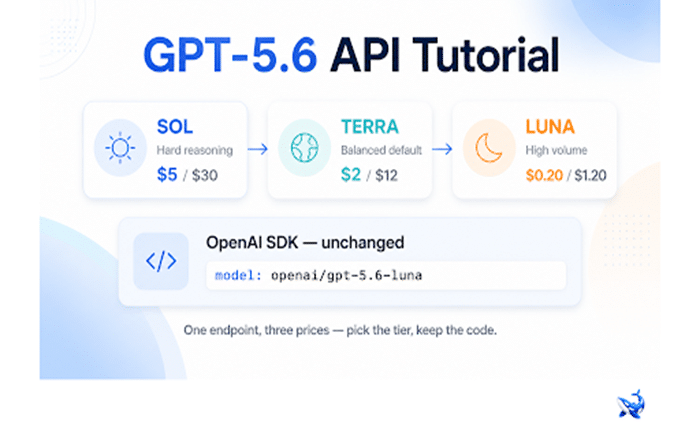
Priced at $0.20 input / $1.20 output per million tokens after the cut — roughly 80% below the launch rate of $1/$6, per OrcaRouter’s price tracking — GPT-5.6 Luna API is the economy-tier model you stop second-guessing before you call it. The catch is quieter: rate limits. GPT-5.6 Luna carries the live rate card and production telemetry a team reads on day one and forgets until the first 429 — and for a model this cheap, the throttle arrives faster than the price implies.
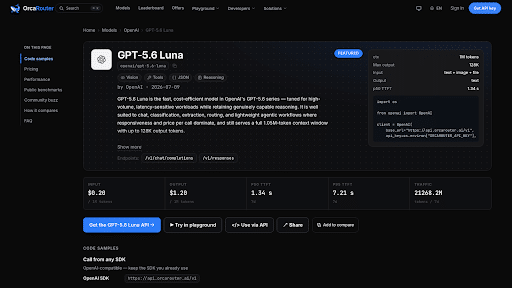
The tension is structural. Luna’s reason for existing is volume: OpenAI positions it as the high-volume economy member of the GPT-5.6 family — released July 9, 2026, per Artificial Analysis — beside Sol and Terra. Price it low enough, and the natural response is to pour throughput into it; throughput is precisely what a rate limit meters. On OrcaRouter’s seven-day telemetry window, Luna moved 21,271.6M tokens — by far the highest volume of any model we track. The volume is real, and so is the quota ceiling sitting behind it.
Rate limits, decoded for an economy tier
OpenAI meters API access two ways. The first is a request budget — RPM, requests per minute — capping how many calls you can fire in a window. The second is a token budget — TPM, tokens per minute — capping how many input and output tokens those requests consume. Both are typically assigned per API key; an organization holds multiple keys, so the practical ceiling usually reads per key rather than per org. Above that sit usage tiers: as an account spends, the vendor raises the limits it grants, so your quota is a function of how much you have already used, not a fixed property of the model. Exact figures vary by account, region and history — trust your own dashboard, not a cached screenshot.
Luna’s 1,000,000-token context (per Artificial Analysis) makes the TPM meter the sharper constraint. A single long-context request can consume a large slice of a token-per-minute budget in one call — which is why, on a very cheap and very big-context model, the TPM line is the one to watch, not RPM.
A price that invites volume, and a meter that counts it
After the cut, the family reads: Sol at $5/$30 (unchanged), Terra at $2/$12 (down from $2.50/$15, roughly 20% off), Luna at $0.20/$1.20 (down from $1/$6, roughly 80% off) — all per OrcaRouter’s price tracking. Nothing else on the sheet moves volume like Luna.
| Tier | Role | Post-cut price, per 1M in/out | Intelligence Index (max) |
| Sol | flagship | $5 / $30 | 60.93 |
| Terra | balanced default | $2 / $12 | 56.58 |
| Luna | economy / high-volume | $0.20 / $1.20 | 52.32 |
Prices are OrcaRouter’s post-cut reference figures [OURS]; Intelligence Index is from Artificial Analysis’ live board [INDEPENDENT], checked August 22, 2026.
Luna takes the cost-per-task title easily: $0.05 per Intelligence Index task on Artificial Analysis’ board — cheapest of 172 models, against $1.23 for Sol and $2.34 for Claude Opus 5 — and it gets there at 156.6 tokens/second median output speed, against 73.7 for Sol and 61.8 for Opus 5 (all AA). A model that cheap and that fast is a standing invitation to turn the traffic up — exactly when the rate limit starts to bite.
The cut is real, not a marketing number: Luna bills at $0.20/$1.20 on our catalog, the post-cut price passed through at 0% markup. When the price is genuinely this low, cost stops being the constraint — the quota becomes it. The pattern is already visible in the wild — Replit’s Free Mode runs on Luna, per our pricing notes: exactly the high-volume workload shape that presses hardest against a limit.
A 102 ms first token — and the concurrency that eats it
Artificial Analysis measures Luna’s time to first token at roughly 102 ms on its board. That is genuinely fast — but the figure is produced one request at a time, on a synthetic prompt, from a single location. Production runs concurrent requests against shared quota, and users experience the tail, not the median of a benchmark run.
OrcaRouter’s own seven-day telemetry across real traffic puts Luna at 1.33 s p50 and 7.32 s p95 time to first token. Same model; the difference between ~102 ms and 1.33 s is contention — other requests queuing ahead of yours at both the model layer and the quota layer.
Two consequences follow. First, design against the p95, not the brochure: a user-facing feature that times out at two seconds will have a bad Tuesday. Second — the rate-limit angle — a fast first token makes the throttle more expensive, not less: the whole point of paying for speed is to feel it, and a 429 or an exhausted quota steals exactly the milliseconds Luna is good at delivering. Fast models are precisely where concurrency planning — how many parallel requests your code issues — decides whether users feel “fast” or “throttled”.
Making a 429 a non-event
A rate limit is only a problem if the code in front of it is rigid. This is where a router earns its place. Load-balancing spreads traffic across capacity instead of stacking every request onto one queue. Retries with backoff turn a transient 429 into a retried request rather than a failed one. Automatic failover means a rejecting endpoint gets routed around, the request served by the next available capacity instead of dropped. Behind a single key that carries 200+ models at 0% markup, that failover becomes a routing rule rather than a second integration.
The principle survives without the plug: a 429 should never be a user-facing error. It should be a scheduling event. A hard retry loop with no backoff converts one 429 into a burst of ten, producing more 429s and a throttle that outlasts the spike. Back off, let the caller’s timeout do the work, and route around the capacity that is out. Luna’s price makes the math friendly: at $0.20/$1.20, retries and redundant capacity cost almost nothing, so failure is cheap to absorb and cheap to avoid.
How tier pricing and limits compound
Usage tiers sit underneath all of this, and they tie price to quota. In the vendor’s model, higher account spend moves an account up a tier, and higher tiers grant larger limits — so the account enjoying the best effective price is also the account with headroom. The interaction cuts both ways.
Upward, the more you spend, the more you are allowed to send — and Luna is the cheapest way to accumulate spend, making it a natural vehicle for climbing tiers cheaply. Downward, quotas are shared across a key: if one workflow runs long-context Luna requests near the 1M-token ceiling, the TPM meter empties long before RPM is ever touched. The practical rule: keep high-volume Luna traffic on a key whose tier is already established, and isolate the workloads that must never wait on separate keys with headroom. None of these thresholds are public constants — check your own dashboard, treat it as the source of truth.
The takeaway
Rate limits are the hidden dimension of Luna’s price. At $0.20/$1.20 it is the cheapest serious model on the board (per OrcaRouter’s price tracking and Artificial Analysis’ cost figures), the fastest first token of its family (roughly 102 ms per AA), and the volume workhorse of our telemetry at 21,271.6M tokens in seven days — and every one of those qualities invites more traffic, exactly what the meter counts.
None of this makes Luna a bad choice; it makes it a good one to architect around. Budget for TPM, not just RPM, on a 1M-context model. Design timeouts against the p95 of real traffic, not the clean-room 102 ms. Put retries, backoff and failover in front of the key so a 429 is a scheduling event and never a user error. For batch, high-volume and cost-sensitive workloads, Luna’s limits are a design input — once you stop reading the pricing line and start reading the quota line.
Sourcing note: post-cut pricing (Sol $5/$30, Terra $2/$12, Luna $0.20/$1.20), the ~80% cut from the $1/$6 launch price, and the 0% markup pass-through are OrcaRouter’s own catalog and blog figures [OURS]. Release date, the 1M context window, Intelligence Index scores (Sol 60.93, Terra 56.58, Luna 52.32), cost per task ($0.05), cost rank (#21/172), time to first token (~102 ms) and median output speed (156.6 tok/s) are Artificial Analysis’ independent measurements [INDEPENDENT], checked August 22, 2026. p50/p95 time-to-first-token (1.33 s / 7.32 s) and seven-day traffic (21,271.6M tokens) are OrcaRouter’s own production telemetry [OURS], checked August 22, 2026. Rate-limit mechanics (RPM/TPM, key- versus org-scoped limits, usage tiers) are described in general terms per the vendor’s published API model; exact quota figures are account-specific and not public constants — your own dashboard is authoritative.